What if your next campaign told customers not to buy from you?
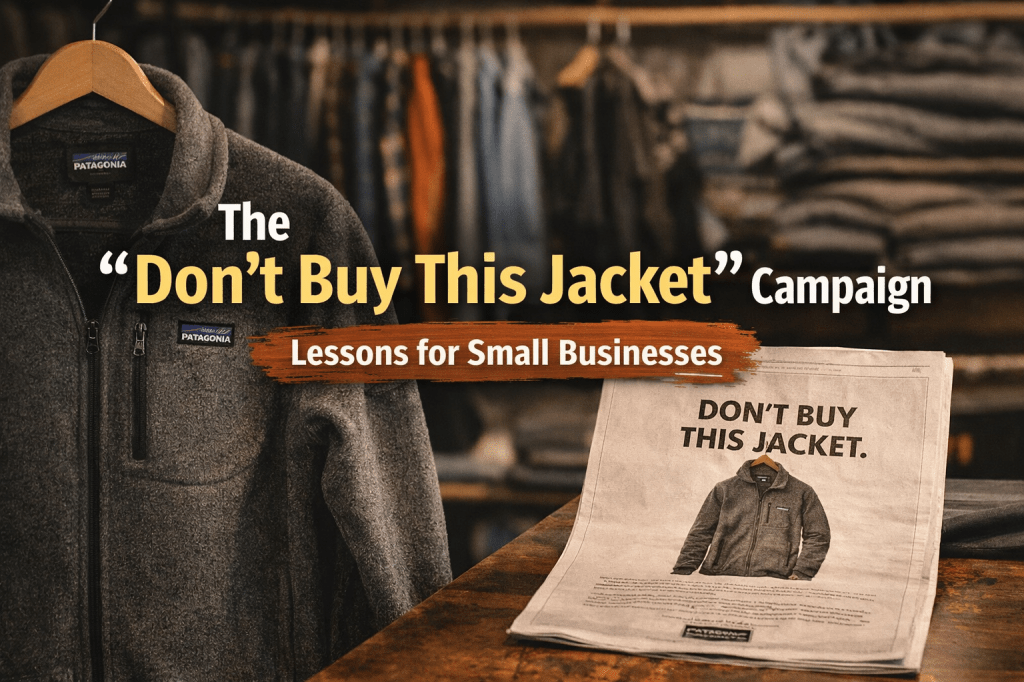
In 2011, outdoor apparel company Patagonia ran a full-page Black Friday ad in The New York Times with a striking headline: “Don’t Buy This Jacket.”
On the biggest shopping weekend of the year, while competitors pushed urgency, discounts, and limited-time offers, Patagonia did the opposite. They asked customers to reconsider consumption. Many marketers assumed it would damage sales. Instead, revenue reportedly increased from roughly $375 million to over $500 million the following year. This was not accidental. It was strategic brand positioning at its finest.
For small and mid-sized businesses, this campaign remains one of the strongest examples of purpose-driven marketing and long-term brand strategy in action.
Standing Out in a Crowded Market
Black Friday marketing tends to follow the same predictable script. Brands compete for attention by amplifying urgency and lowering prices. When every company sounds the same, consumers stop listening.
Patagonia broke that pattern.
By telling customers not to buy, they created immediate curiosity and cognitive dissonance. The message forced readers to pause. In marketing psychology, this technique is known as pattern interruption. When every brand zigs, the one that zags earns attention.
For small businesses competing against larger brands with bigger budgets, this principle is critical. You rarely win by outspending competitors. You win by positioning yourself differently. Strategic differentiation often outperforms aggressive promotions, especially in saturated markets.
Why Transparency Builds Brand Trust
The brilliance of the campaign was not just in the headline. The ad explained the environmental cost of producing the jacket, including water usage, carbon emissions, and waste. Instead of presenting a polished, perfect image, Patagonia acknowledged its impact.
This approach aligns with broader consumer behavior data. Research from Nielsen has shown that a majority of global consumers are willing to pay more for sustainable brands. Modern buyers value transparency and responsibility.
For small and mid-sized businesses, this is an important shift. You do not need to be flawless to earn trust. You need to be honest. When companies openly communicate trade-offs, explain their pricing, or share their improvement efforts, credibility increases. Over time, that credibility compounds into customer loyalty and repeat revenue.
Trust is no longer a soft metric. It is a growth strategy.
Purpose-Driven Marketing vs. Promotion-Driven Marketing
Patagonia was not simply selling a jacket. The campaign reinforced a long-standing environmental mission embedded into the company’s operations. Years later, founder Yvon Chouinard transferred ownership of the company into a structure designed to ensure profits support climate initiatives. That consistency made the “Don’t Buy This Jacket” message believable.
For small businesses, purpose-driven marketing does not require global activism. It requires clarity. When you are clear about what you stand for, the problem you are committed to solving, and the change you want to create for customers, your marketing becomes more than persuasion. It becomes an alignment.
Customers today are not just buying products or services. They are choosing brands that reflect their values and identity. When messaging, operations, and customer experience align, marketing stops feeling transactional and starts feeling relational.
What This Means for SMB Marketing Strategy
The real lesson for small and mid-sized businesses is not to copy a controversial headline. It is to understand the strategic foundation beneath it.
Long-term brand loyalty strategies are built on trust, consistency, and clarity of values. When businesses address objections openly, explain their approach transparently, and prioritize long-term relationships over short-term conversions, they create deeper customer loyalty.
In an era dominated by AI-generated content, automated ads, and aggressive funnels, attention is easy to buy. Trust is not. Sustainable growth for SMBs comes from clear positioning, authentic storytelling, and consistent brand experience across your website, social platforms, and sales conversations.
The Bigger Takeaway
Patagonia demonstrated that when values and marketing align, bold messaging does not repel customers. It attracts the right ones.
For small businesses looking to strengthen their marketing strategy, the opportunity is not to be louder. It is to be clearer. Clear about your values. Clear about your impact. Clear about who you serve and why you exist.
Because when customers believe in what you stand for, they do not just buy once. They stay.
Ready to Build a Brand People Believe In?
If you are a small or mid-sized business looking to move beyond discount-driven marketing and build real brand authority, it may be time to rethink your positioning.
Are you clear about what you stand for?
Is your messaging aligned with your operations?
Are you building trust or just chasing clicks?
👉 If you want a marketing strategy rooted in clarity, differentiation, and long-term growth, let’s start that conversation. The strongest brands are not built on louder ads. They are built on stronger foundations.
 WellKnit Marketing | Digital Marketing & Performance Agency in Toronto
Leave a comment